



Reverse Transcriptase
Reverse transcriptases (RTs) are enzyme used to generate complementary DNA (cDNA) from an RNA template, a process termed reverse transcription. Reverse transcriptases (RTs) use an RNA template and a short primer complementary to the 3' end of the RNA to direct the synthesis of the first strand cDNA.
Nucleoside reverse transcriptase inhibitors (NRTIs) block reverse transcriptase (an HIV enzyme). Non-nucleoside reverse transcriptase inhibitors (NNRTIs) bind to and block HIV reverse transcriptase. HIV uses reverse transcriptase to convert its RNA into DNA (reverse transcription). Blocking reverse transcriptase and reverse transcription prevents HIV from replicating.
All Product Categories
-
Reverse Transcriptase Related Products (277)
Related Products (277)

-
NNRT-IN-15
 0 ImagesCat. No.: HY-181034NNRT-IN-15 (Compound 16a) is a potent non-nucleoside reverse transcriptase (NNRT) inhibitor. NNRT-IN-15 shows an EC50 of 3 nM for WT HIV-1 and inhibits seven mutant strains (L100I, K103N, Y181C, etc.) (EC50 = 8.2-43.4 nM). NNRT-IN-15 has low cytotoxicity against MT-4 cells (CC50 = 196.46 μM). NNRT-IN-15 also inhibit WTHIV-1RT and hERG with IC50 values of 0.7599 μM and 27.455 μM. NNRT-IN-15 can be used for research of HIV-1 infection.
-
Tenofovir alafenamide hemifumarate (Standard)
 0 ImagesSynonyms: GS-7340 hemifumarate (Standard)Tenofovir alafenamide hemifumarate (Standard) is the analytical standard of Tenofovir alafenamide hemifumarate. This product is intended for research and analytical applications. Tenofovir alafenamide hemifumarate (GS-7340 hemifumarate) is an investigational oral proagent of Tenofovir. Tenofovir is a HIV-1 nucleotide reverse transcriptase inhibitor.
-
Rilpivirine-13C6
 0 ImagesCat. No.: HY-10574S1Synonyms: R278474-13C6; TMC278-13C6; DB08864-13C6Rilpivirine-13C6 (R278474-13C6) is 13C labeled Rilpivirine. Rilpivirine (R278474) is a potent and specific diarylpyrimidine (DAPY) non-nucleoside reverse transcriptase inhibitor (NNRTI). Rilpivirine has high antiviral activity against wild-type HIV (EC50=0.4 nM) and mutant viruses (EC50=0.1-2.0 nM). Rilpivirine has a high genetic barrier to resistance development of HIV.
-
Tenofovir maleate
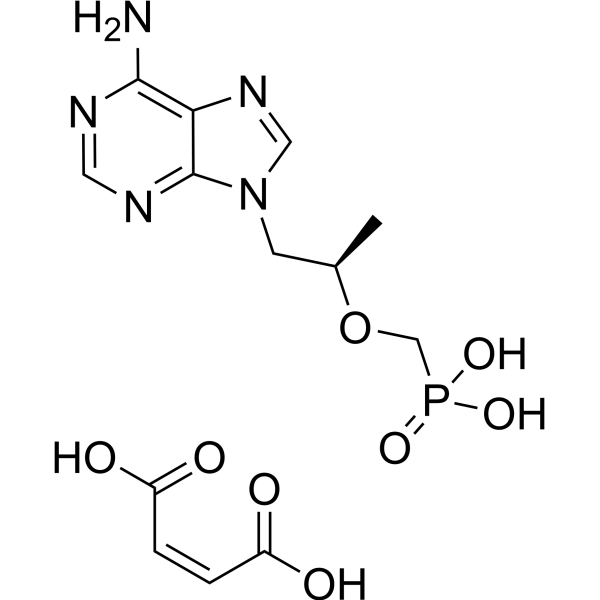 0 ImagesCat. No.: HY-13910BCAS No.: 1236287-04-9Synonyms: GS 1278 maleate; PMPA maleateTenofovir maleate (GS 1278 maleate; PMPA maleate) is a nucleotide reverse transcriptase inhibitor to treat HIV and chronic Hepatitis B (HBV).
-
GW695634
 0 ImagesCat. No.: HY-123330CAS No.: 457635-65-3GW695634 is an orally active prodrug of GW678248. GW695634 undergoes amidolysis in vivo to release the active ingredient GW678248, thereby inhibiting viral replication. GW678248 is a non-nucleoside reverse transcriptase inhibitor (NNRTi) with potent antiviral activity against Efavirenz (HY-10572)-resistant and Nevirapine (HY-10570)-resistant HIV and AIDS viruses.
-
NNRT-IN-5
 0 ImagesCat. No.: HY-169207CAS No.: 3032803-00-9NNRT-IN-5 (compund 10d) is an orally available non-nucleoside reverse transcriptase inhibitor.
-
(Z)-Rilpivirine
 0 ImagesCat. No.: HY-167642CAS No.: 500287-94-5Synonyms: (Z)-R278474; (Z)-TMC278; (Z)-DB08864(Z)-Rilpivirine ((Z)-R278474) is the (Z)-isomer of Rilpivirine (HY-10574). Rilpivirine is an effective and selective diarylpyrimidine (DAPY) non-nucleoside reverse transcriptase inhibitor (NNRTI). It exhibits potent antiviral activity against both wild-type HIV (EC50 = 0.4 nM) and mutant strains (EC50 = 0.1-2.0 nM).
-
Didanosine (Standard)
 0 ImagesSynonyms: 2',3'-Dideoxyinosine (Standard); ddI (Standard)Didanosine (Standard) is the analytical standard of Didanosine. This product is intended for research and analytical applications. Didanosine (2',3'-Dideoxyinosine; ddI) is a a potent and orally active dideoxynucleoside analogue, and also is a potent nucleoside reverse transcriptase inhibitor. Didanosine shows antiretroviral activity for HIV.
-
Tenofovir disoproxil aspartate
 0 ImagesCat. No.: HY-115430CAS No.: 1571075-19-8Tenofovir disoproxil aspartate is a nucleotide reverse transcriptase inhibitor used to treat HIV and chronic Hepatitis B.
-
Mniopetal C
 0 ImagesCat. No.: HY-N14286CAS No.: 158761-00-3Mniopetal C is a reverse transcriptase inhibitor found in Mniopetalum sp. 87256.
-
Delavirdine mesylate (Standard)
 0 ImagesCat. No.: HY-10571ARCAS No.: 147221-93-0Synonyms: U 90152 mesylate (Standard); BHAP-U 90152 mesylate (Standard)Delavirdine (mesylate) (Standard) is the analytical standard of Delavirdine (mesylate). This product is intended for research and analytical applications. Delavirdine (U 90152) mesylate is a potent, highly specific and orally active non-nucleoside reverse transcriptase inhibitor (NNRTI). Delavirdine mesylate selectively inhibits HIV-1 reverse transcriptase (RT) (IC50=0.26?μM) over DNA polymerase?α?(IC50=440 μM) and polymerase?δ (IC50>550?μM). Delavirdine mesylate is an inhibitor of HIV-1 replication and can can be used for the study of AIDs.
-
Efavirenz-d5
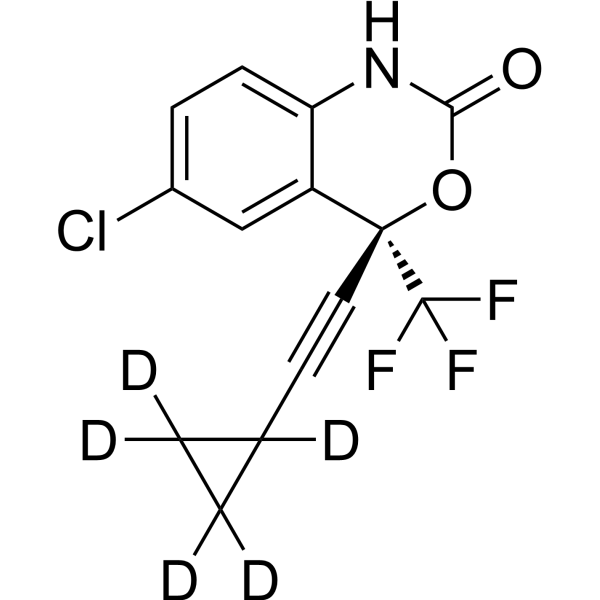 0 ImagesCat. No.: HY-10572SCAS No.: 1132642-95-5Efavirenz-d5 (DMP 266-d5) is the deuterium labeled Efavirenz. Efavirenz (DMP 266) is a potent inhibitor of the wild-type HIV-1 reverse transcriptase with a Ki of 2.93 nM and exhibits an IC95 of 1.5 nM for the inhibition of HIV-1 replicative spread in cell culture. Efavirenz-d5 is a click chemistry reagent, it contains an Alkyne group and can undergo copper-catalyzed azide-alkyne cycloaddition (CuAAc) with molecules containing Azide groups.
-
HIV-1 inhibitor-79
 0 ImagesCat. No.: HY-169920HIV-1 inhibitor-79 (Compound 3k) is an HIV inhibitor that exhibits significant inhibitory activity against HIV-1 and its common mutant strains (with IC50 values of 1.9, 1.9, 8.7, and 11 nM against HIV-1, K103, L100I, and E138K, respectively), and has low cytotoxicity and a high selectivity index (CC50 = 21.95 μM, SI = 11478). Additionally, HIV-1 inhibitor-79 also shows antiviral activity against HIV-2, with an EC50 value of 6.14 μM, and significantly inhibits the activity of HIV-1 reverse transcriptase (IC50 = 25 nM).
-
Etravirine-d8
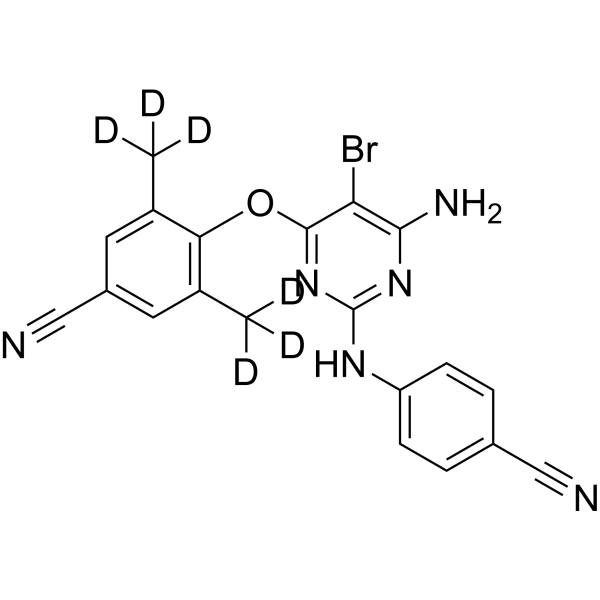 0 ImagesCat. No.: HY-132508SCAS No.: 1142096-06-7Etravirine-d8 is the deuterium labeled Etravirine. Etravirine (R165335) is a non-nucleoside reverse transcriptase inhibitor (NNRTI) used for the treatment of HIV.
-
Lamivudine-13C,15N3
 0 ImagesCat. No.: HY-B0250S2CAS No.: 1261394-64-2Synonyms: BCH-189-13C,15N3Lamivudine-13C,15N3 (BCH-189-13C,15N3) is 13C and 15N labeled Lamivudine. Lamivudine (BCH-189) is an orally active nucleoside reverse transcriptase inhibitor (NRTI). Lamivudine can inhibit HIV reverse transcriptase 1/2 and also the reverse transcriptase of hepatitis B virus. Lamivudine salicylate can penetrate the CNS.
-
Digallic acid
 0 ImagesDigallic acid is an antioxidant, antimutagenic, antigenotoxic, and anti-hyperuricemic compound. Digallic acid is a reverse transcriptase and XOD, URAT1 (IC50: 5.34 μM) inhibitor. Digallic acid scavenges DPPH· and O2·− radicals. Digallic acid induces apoptosis. Digallic acid can be isolated from the fruits of Pistascia lentiscus.
-
INDOPY-1
 0 ImagesCat. No.: HY-182474CAS No.: 352548-47-1Synonyms: Indolopyridone-1INDOPY-1 (Indolopyridone-1) is a selective, reversible, and competitive HIV-1 reverse transcriptase inhibitor. INDOPY-1 reversibly binds to the active site of reverse transcriptase. INDOPY-1 inhibits DNA synthesis. INDOPY-1 exhibits antiviral activity against various retroviruses, including HIV-1 IIIB, HIV-1 HXB2 K103N Y181C, HIV-2 ROD, and SIV Mac251. INDOPY-1 can be used in the research of immunodeficiency virus infection.
-
Mniopetal A
 0 ImagesCat. No.: HY-N14284CAS No.: 158760-98-6Mniopetal A is a reverse transcriptase inhibitor found in Mniopetalum sp. 87256.
-
Azvudine (Standard)
 0 ImagesCat. No.: HY-19314RCAS No.: 1011529-10-4Synonyms: RO-0622 (Standard); FNC (Standard)Azvudine (Standard) is the analytical standard of Azvudine. This product is intended for research and analytical applications. Azvudine (RO-0622) is a potent nucleoside reverse transcriptase inhibitor (NRTI), with antiviral activity on HIV, HBV and HCV. Azvudine exerts highly potent inhibition on HIV-1 (EC50s ranging from 0.03 to 6.92 nM) and HIV-2 (EC50s ranging from 0.018 to 0.025 nM). Azvudine inhibits NRTI-resistant viral strains. Azvudine is a click chemistry reagent, it contains an Azide group and can undergo copper-catalyzed azide-alkyne cycloaddition reaction (CuAAc) with molecules containing Alkyne groups. It can also undergo strain-promoted alkyne-azide cycloaddition (SPAAC) reactions with molecules containing DBCO or BCN groups.



